
Sunday, March 31
Sleeping Dogs Review (PS3): Undercover Gangster's Paradise
This summary is not available. Please
click here to view the post.


Saturday, March 9
Polygon's SimCity review is busted policy in action

I'm not a professional games writer. I've wanted to be one since I first picked up a compendium of reviews for games on the Sega Master System and Mega Drive (Genesis), but I've made peace with the fact that I'll always be a commentator more than a genuine contributor. That, and my current occupation - providing policy advice and administration services in a university context - has done a good job of putting food on my table and a roof over my head. You might see me pop up on a few different gaming sites, but rest-assured my money has and will pretty much always be earned elsewhere. I hope that with this introduction, you'll be satisfied that this examination of relatively-new games website, Polygon's review process and policy isn't sour grapes; it's me looking at games writing in the context of my day job.
Polygon's review policy, titled Polygon's Review Scores and "The Bump" is about as toothless and cosmetic as policy documents come. There's a pretty lengthy preamble to give the reader context as to why an outlet would have an actual policy to begin with, and this primarily relates to the evolving nature of the game as a product. There's no definitive purpose spelled out in the document, and by that I mean I couldn't tell you what purpose a Polygon review is supposed to serve other than to establish and maintain the site's "legacy and credibility." There is an acknowledgement that reviews are valuable to the site's readership, but also a puzzling commitment to "being as fair as possible to the developers and publishers who pour time and money into the games you play." Is a Polygon review supposed to be a purchase recommendation or an evaluation of a game under ideal conditions? From the policy document, it's difficult to say for sure.
There is one statement in the policy for which I intend to take Polygon to task for though, and it reads as follows:
At Polygon, we operate on the supposition that reviews are a critical evaluation of a game on the day of its release, which the score we assign reflects.If the review is supposed to be a "critical evaluation of a game on the day of its release," then this should imply a few things that would put it at odds with the typical games website milieu of assessing review code in the weeks leading up to release, sometimes at events held at the publisher's offices. Ideally, a review under this supposition would be conducted using a retail copy of the game. I wouldn't expect them to buy it - publisher supplied would be above board - but the publication's recent review of SimCity along its with subsequent revisions shows just how meaningless the policy and the concept of "The Bump" really is.

To be clear, I'm not alleging that there's any impropriety on the part of the reviewer, Russ Pitts or Polygon's Reviews Editor, Arthur Gies: it is stated in the site's forums, publicly on Twitter, and in the review itself that the game was trialled on "development servers". I am, however, implying that Polygon's review policy is for show only, with its writers being able to point to it as proof of the site's supposed integrity rather than it guiding the site's process and practices.
The flippant references to the testing conditions in the cut-away headed On "Always-Online" effectively highlights how the initial review contravenes the review policy: "on the day of its release," readers won't be able to play the game "on one of their (EA's) reserved servers," or "offline in a private server environment with no other invited players." A quick Google search reveals a multitude of reports on how readers (and anyone else who purchased SimCity for that matter) endured great trouble playing the game that they paid for on the release date and afterwards.
The employment of The Bump seemed to be at odds with the grand scheme of the broken policy as well. To acknowledge the trouble that most consumers have endured trying to connect to EA's servers and actually play SimCity on release (March 5), Gies employed The Bump and reduced the game's review score from a near-perfect 9.5 to a still respectable 8.0. Just two days later, the score dropped significantly to 4.0 to recognise the withdrawal of certain features that apparently affected Pitts' enjoyment of SimCity. Once again, to quote the policy, review updates are supposed to chart the "timeline of that game's evolution." I would argue that it's not to document launch hiccups.
Polygon's review of another always-online PC title that endured issues with access at launch, Diablo III is proof of my assumptions regarding the intent of the policy. In another cut-away, this time titled Server Issues, Arthur Gies explains why the dungeon crawler's score remained at a perfect 10 with the following:
Ordinarily, my position as Reviews Editor at Polygon is that we review a game as it exists on release day, because our responsibility is to our audience. While we do all we can to maintain due diligence with regards to giving a game every opportunity to deliver, we choose your wallet and your time before the benefit of the doubt.
But Diablo 3 is different. It's different because Blizzard has a track record spanning almost two decades of games that have become institutions, and they've also run the most popular MMO around for almost eight years. Put simply, Blizzard, more than any developer around, has earned that benefit of the doubt. I believe that the server issues will be resolved. With that in mind, it does both our audience and Diablo 3 a disservice to dwell on that aspect in this review.So in this case, Blizzard, a high-profile developer that has experience delivering games with online infrastructure is spared the wrath of The Bump as "they've earned the benefit of the doubt." I can't attest to developer Maxis' experience with online-only products, but it's publisher, EA has released a vast catalogue of online-dependent or otherwise enabled titles in a variety of genres. For what reason does the Polygon review team believe that EA is unable to deliver a stable experience? How have they not earned the benefit of the doubt? At least in the case SimCity, Maxis delivered the product in full and withdrew features (and will presumably restore them once the servers become stable), as opposed to Diablo III where the real money auction house and Player versus Player features weren't ready for the release date and took varying amounts of time to be delivered.

This lack of consistency again raises the question of what purpose the review is supposed to serve - not just at Polygon, but at games writing outlets in general? Is the review supposed to be a purchase recommendation for readers? If so, Polygon did a disservice to their audience by trialing the game in conditions different to those that would be available to consumers and rendering a near-perfect score. Besides, it's not like The Bump will carry over to Metacritic - whose ratings are the only thing arguably close to an objective measure in terms of games reviews. Surely, with the collective experience of Diablo III's muddled launch, the Polygon team must've thought it prudent to test the retail servers before publishing a review for another always-online game. Then again, if the review is supposed to assess the game in ideal conditions, then The Bump should never have been applied as Pitts got to see the game at its best.
I approached both Pitts and Gies with my concerns via Twitter, and received a reply from the reviewer (Pitts) who stated (across multiple tweets) that:
We did our best to ensure we were reviewing the game in conditions as approximating the user experience as closely as possible. That's not always going to be 100%. And in this case, launch conditions were far more terrible than anyone assumed. Hence, the repeated updates. TL;DR: This is an extreme case of almost everything.I responded with the allegation that, as per the above, that Polygon's policy is more for show and highlighted both the breach of policy and the inconsistency with regards to the outlet's Diablo III review and was told that:
It's not that simple, but I appreciate your feedback. Definitely something to consider.Look, I'm not naive. I know that most gaming sites live and die by their reviews, and that waiting to trial the game on retail servers would have cost Polygon no small amount of hits. Further to that, it's possible that non-disclosure agreements were signed and delivery dates may have been promised. I don't know all the factors that were at play, but I know that Pitts was being genuine with his response. When we're talking about "legacy and credibility" and integrity, however, sacrifices need to be made. I mean, why have a policy if you have no intention of honouring it? I'd point to Gamespot, and their Senior Editor, Kevin Van Ord's review of SimCity as an example of best practice: it acknowledges the broken state of the game as well as highlighting promising aspects which just weren't functional at launch. I think if you're going to apply a bump to the review score, you should start with the product that was delivered to consumers and work up (or down) from there.
I work with well-written policies and I work with dated, ineffective ones as well. A good policy accounts for most situations and variables while allowing sufficient flexibility through interpretation for the benefit of stakeholders. Polygon's review policy is not a well-written policy, and while not old, has already been rendered ineffective by the business of video games writing. If you want that audience -- or better yet, to expand it -- you've got to go to press early, first if you can. Promising to evaluate something close to what your readership will have in its collective hands is at odds with this business model, so Polygon has to make a choice: do you stand with your audience, or do you postulate to them? Whatever the answers to this question and the others published above, I think the site's management need to revise the policy or consider withdrawing it altogether.
Update (14/03/13):
Polygon's Diablo III review was published prior to the website's official launch (it was first published on The Verge) and before the review policy was actually written. Still, I think given the
flippant way in which Diablo III's server issues were addressed,
it's unfair and inconsistent for SimCity's score to have been reduced
so drastically given that server capacity and features disabled will
more than likely return in due time.
The
fact remains that Polygon have previously reviewed an "always-online"
title and the server issues didn't even factor into the
original score awarded because of the aforementioned "benefit of the doubt". Further to that, the review policy would've been written after the Diablo III review and the ruling regarding launch woes and "benefit of the doubt" should've factored into the outlet's approach to policy development.
Friday, March 1
The Hard Way with Metal Gear Rising: Revengeance

Note: This post contains spoilers for Metal Gear Rising: Revengeance.
When I finished DmC: Devil May Cry a few weeks ago, the first thing I did was dive into a "Son of Sparda" run - which presented vastly more difficult enemy configurations and a reworked damage model. I put on a brave face for the first mission, but before long, I was up against Butchers as well as Ghost and Blood Rages that broke me and any chance of conquering a greater challenge. I don't think I've ever completed a "Hard" playthrough of any 3D brawler, now that I think about it. I've started quite a few -- even came close to finishing the original Devil May Cry -- but never quite had the resolve or the wits to rise above Normal in anything from Maximo to Bayonetta.
SPOILERS FROM HERE ON. YOU'VE BEEN WARNED!
SPOILERS FROM HERE ON. YOU'VE BEEN WARNED!
Despite reading that Metal Gear Rising: Revengeance was beyond brutal via the likes of Kotaku and my Twitter feed, I thought I handled its bombastic brand of butchery with aplomb. Sure, I may have only attained a C ranking for my Normal playthrough, but Platinum seemed to be quite punitive with regards to their grading schema. I could only see one C grade on my entire report card (displayed upon completing the campaign) but all of those As and Bs weren't enough to earn me more than a pass overall. Regardless of the mediocre ranking, I felt that post Blade Wolf, I was rarely troubled by the Winds of Destruction or even the monstrous new iteration of Metal Gear that awaited me in the final stage.
With regards to difficulty, Revengeance plateaus after the duel with the carbon canine on the default setting; which falls roughly half way through the second level or about an hour of play. There are some small spikes in the level of challenge that you'll encounter, but if you can tough out that first real obstacle, then I have faith that you're up to the task of completing the game on Normal.
I found that the flow changed slightly when I ascended the scale for a New Game Plus playthrough. The plateau still hits really early -- earlier in fact -- but so long as you as you parry often and make the most of both Blade and Ripper modes to reap as many spines as possible, you'll survive. Those sword upgrades and an expanded move list help a great deal as well, but you'll need to endure some pain to access the fruits of your lower difficulty labours. What I'm trying to say is, New Game Plus doesn't start until you finish the prologue. "No sweat," you reply, but can your confidence withstand a stronger, more durable Metal Gear Ray? I used the majority of fourteen continues in the first stage of that boss fight. The plasma cannon attack is just shy of an instakill for Raiden without the extra cyborg upgrades, so be sure to avoid Ray's wide, deadly... erm... ray. I learned that the surest way to survive the first two parts of the fight is to slice incoming missiles for repair units. It's tough going, but YouTube, as always, offers a wealth of strategies and revelations if you need them (example: you can parry the immense machine's stomp attacks!).
The level of challenge flatlines once Raiden gets a hold of his new body. The first Blade Wolf can be worn down in seconds, and the encounter with Mistral was a breeze (though I should note that it's just as visually arresting the second time around). I didn't find a need for repair paste for a couple of hours - something I'd have found hard to believe whilst initially coming to grips with Revengeance's fast-paced combat system.
Monsoon marked the first bump in the road of my Hard run. One of the few boss fights that requires parries from beginning to end, he whittled down my stock of healing items before I cut him into one hundred tiny slivers. He still couldn't take my life though; nor could the doppelgangers, nor could Sundowner. Sam was just as delicate, if not, more so on Normal. All but the final stage was cause for any real concern. Sure, there were some instances where I had to swallow my pride: the minigun turrets couldn't survive the defense of World Mashall's lobby, I Ninja Ran to my death while traversing the rooftops of Denver, the cargo elevator fight knocked me around a bit, and I generally lost a lot more life than I should have when dealing with Mastiffs... at any time.

I found that the flow changed slightly when I ascended the scale for a New Game Plus playthrough. The plateau still hits really early -- earlier in fact -- but so long as you as you parry often and make the most of both Blade and Ripper modes to reap as many spines as possible, you'll survive. Those sword upgrades and an expanded move list help a great deal as well, but you'll need to endure some pain to access the fruits of your lower difficulty labours. What I'm trying to say is, New Game Plus doesn't start until you finish the prologue. "No sweat," you reply, but can your confidence withstand a stronger, more durable Metal Gear Ray? I used the majority of fourteen continues in the first stage of that boss fight. The plasma cannon attack is just shy of an instakill for Raiden without the extra cyborg upgrades, so be sure to avoid Ray's wide, deadly... erm... ray. I learned that the surest way to survive the first two parts of the fight is to slice incoming missiles for repair units. It's tough going, but YouTube, as always, offers a wealth of strategies and revelations if you need them (example: you can parry the immense machine's stomp attacks!).
The level of challenge flatlines once Raiden gets a hold of his new body. The first Blade Wolf can be worn down in seconds, and the encounter with Mistral was a breeze (though I should note that it's just as visually arresting the second time around). I didn't find a need for repair paste for a couple of hours - something I'd have found hard to believe whilst initially coming to grips with Revengeance's fast-paced combat system.
Monsoon marked the first bump in the road of my Hard run. One of the few boss fights that requires parries from beginning to end, he whittled down my stock of healing items before I cut him into one hundred tiny slivers. He still couldn't take my life though; nor could the doppelgangers, nor could Sundowner. Sam was just as delicate, if not, more so on Normal. All but the final stage was cause for any real concern. Sure, there were some instances where I had to swallow my pride: the minigun turrets couldn't survive the defense of World Mashall's lobby, I Ninja Ran to my death while traversing the rooftops of Denver, the cargo elevator fight knocked me around a bit, and I generally lost a lot more life than I should have when dealing with Mastiffs... at any time.

Metal Gear Excelsus and Senator Armstrong were the only other challenges encountered. Much like the first time I dueled with the screen-hogging mech, the seemingly-open nature of this particular battle caught me unawares and claimed my life a few times. There's a sense of intimacy that goes with battling the Winds of Destruction that is absent here: even though Raiden's still confined to a relatively small area, the vastly greater dimensions of this opponent again proved both disorienting and daunting. It was by luck that I managed to avoid some of Excelsus's more damaging attacks by performing a Zandatsu on one of the Gekkos that are thrown into the field about halfway through the fight. Blade energy and vitality restored, I managed to sneak through to the final showdown with one precious serving of repair paste.
The battle, that is to say the actual fighting against Armstrong, was surprisingly easy. The dodge attack was more effective here than in any other scenario: dealing relatively high amounts of damage and conveniently sidestepping pretty much anything in the muscle-bound politician's repertoire. It did, however, take a few attempts to cut through various parts of Metal Gear Excelsus that were hurled towards me. Having to use both sticks to line up the required angle without prematurely slicing was no small feat as I'd long grown accustomed to mashing square and triangle in Blade Mode without much care for accuracy. A few precise cuts later though and Revengeance came to a spectacularly violent close once again.
What did I earn from my victory? Not a great deal other than some pride and a few trophies that could otherwise have been earned on any other difficulty. I attained the same overall ranking, the same titles and a new skin.
I may not have attained many tangible rewards from this endeavour, but I did find enough confidence to venture into Very Hard. Two Blade Wolves and a Gekko before you even reach the first checkpoint, with no upgrades and no dodge attack. No thanks, Platinum. No thanks.
How do you like your brawlers? Do you prefer the default difficulty setting, or do you thirst for a true challenge?
The battle, that is to say the actual fighting against Armstrong, was surprisingly easy. The dodge attack was more effective here than in any other scenario: dealing relatively high amounts of damage and conveniently sidestepping pretty much anything in the muscle-bound politician's repertoire. It did, however, take a few attempts to cut through various parts of Metal Gear Excelsus that were hurled towards me. Having to use both sticks to line up the required angle without prematurely slicing was no small feat as I'd long grown accustomed to mashing square and triangle in Blade Mode without much care for accuracy. A few precise cuts later though and Revengeance came to a spectacularly violent close once again.
What did I earn from my victory? Not a great deal other than some pride and a few trophies that could otherwise have been earned on any other difficulty. I attained the same overall ranking, the same titles and a new skin.
I may not have attained many tangible rewards from this endeavour, but I did find enough confidence to venture into Very Hard. Two Blade Wolves and a Gekko before you even reach the first checkpoint, with no upgrades and no dodge attack. No thanks, Platinum. No thanks.
How do you like your brawlers? Do you prefer the default difficulty setting, or do you thirst for a true challenge?
Sunday, February 24
Metal Gear Rising: Revengeance Review (PS3): A Cut Above

Note: A copy of the game was provided by Mindscape Asia Pacific for the purpose of this review.
I think it's fair
to say that Kojima Productions wasn't quite sure what the Metal Gear universe would look like between
the events of Metal Gear Solid
2: Sons of Liberty and Metal Gear Solid 4: Guns of the
Patriots (MGS4); and
to be fair, neither did I. I think it's also pretty apt to say that they didn't
quite know how to successfully merge stealth and swordplay, as Metal Gear Rising had languished in development
hell since 2009. Perhaps realising that they were in over their head,
development duties were handed over to Platinum Games -- of Bayonetta fame --
in late 2011. Further to that, the decision was made to set what was Metal Gear Rising after MGS4 and add a subtitle: Revengeance. With a
powerfully-silly new name and a fresh set of hands at the wheel, Raiden's
passage through Vapourware Limbo was assured, though I must admit some
trepidation upon first catching the reveal trailer. My doubts have finally been
proven unfounded, however, as Revengeance is one of the finest brawlers
that I've ever played.
A word of warning
to start, the game does its best to break you in its first hour, with a
woefully-steep learning curve and some difficult boss encounters that are sure
to slow your progress out of the gate. I must admit that if it weren't for the
fact that I had played the demo, the duel with Blade Wolf may have affected my
overwhelmingly-positive overall impression. Still, it must be said -- and it
has been, well for that matter by Kotaku's
Evan Narcisse, Kirk Hamilton and Chris Person -- that Platinum does a
terrible job of showing you the ropes.
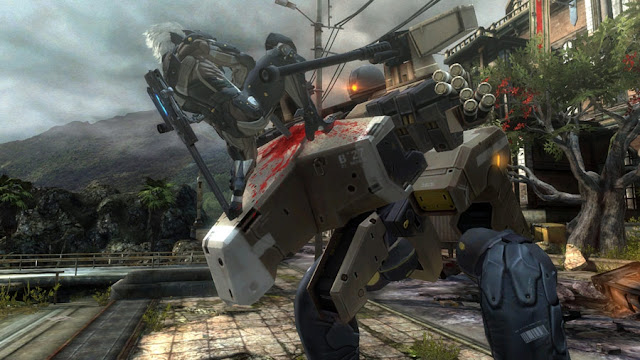

I found the
decision to lock (as in you'll need to "un") the dodge attack to be a
huge oversight as, for games of this ilk, the ability to dance around enemy
attacks is nothing shy of essential. Considering how cheap it is, it's almost
criminal that it's not available from the get go. The odds are stacked against
you, and early, but allow me to drop this hint: equip your repair paste (press
left on the d-pad to bring up the equipment menu) ASAP and unlock the dodge
attack once you earn the requisite BP; your experience with Revengeance will be all the better for
it.
The combat system
is satisfying, and not just because you can rip the spines out of your enemies
and cut them into as many as two hundred and fifty-three pieces (my record, it was a helicopter). Swordplay
works because finesse is rewarded and there are obvious cues to prompt the player to the use the game's key mechanics. That and it looks ridiculous. Via judicious use of Blade Mode -- which allows
Raiden to deal massive damage through precision strikes -- and parries, players are able to cut through most battles with a minimum of both time and fuss. If your sword strikes are sufficiently accurate, you can then pull off the Zandatsu technique, which allows Raiden to rip the repair unit (looks suspiciously like a spinal chord) out of pretty much any enemy combatant to replenish life and blade energy. There's a lot to take in and not every fight will go according to plan, but when it does, the feeling of exhilaration and raw power that you'll feel is unmatched.
If you're having trouble with timing your counters or miss cues to enter Blade Mode against vulnerable enemies, you can still grind your way through most battles by using standard attacks and combos which will have Raiden breakdancing foes to their knees, perhaps even removing them in the process. Your garden variety cyborgs can be filleted without much ceremony, but the larger foes -- and believe me, they're as numerous as they are diverse -- usually require a bit of a warm up before the optimum conditions for surgery are met. There's also unlockable melee weapons and secondary weapons -- including various forms of grenades and launchers -- that require just a little bit too much effort to use, but all things considered, there's plenty of ways to cut through swaths of enemy combatants.
If you're having trouble with timing your counters or miss cues to enter Blade Mode against vulnerable enemies, you can still grind your way through most battles by using standard attacks and combos which will have Raiden breakdancing foes to their knees, perhaps even removing them in the process. Your garden variety cyborgs can be filleted without much ceremony, but the larger foes -- and believe me, they're as numerous as they are diverse -- usually require a bit of a warm up before the optimum conditions for surgery are met. There's also unlockable melee weapons and secondary weapons -- including various forms of grenades and launchers -- that require just a little bit too much effort to use, but all things considered, there's plenty of ways to cut through swaths of enemy combatants.
Boss fights and
the narrative context surrounding them evoke thoughts of Old West showdowns, Might Morphin Power Rangers'
level ceremony and Dragon Ball
Z-esque speed and scale. There's only one real disappointment,
though on the whole, these encounters are a great fit as there are almost no
cheap hits, plenty of forgiving quick-time events and some truly spectacular
visual sequences on offer. Combat rules apply to boss fights as well, so you
can parry the majority of their attacks, but, as with most other encounters,
you can combo your way to a win without need of precise counters. In another
nod to its developer's progeny (Bayonetta and Devil May Cry), some fights
repeat, but the fields in which they take place can vary, meaning that the
tactics required are different. These large scale bouts are a real highlight
and some even stand amongst the best I've seen in brawlers past.


Camera quirks and
unresponsive context-sensitive commands do spoil the party somewhat, but with a
bit of patience safe passage is all but assured. Camera position is key to
successful parries as you need to meet your opponent's strike with a directed
light attack. Whenever there's any distance between Raiden and an opponent, the
player's view of the battlefield will most often be obscured; in that you'll
either lose sight of your intended target or, perhaps more troubling, lose
sight of the healing items or collectibles for which you had decided to put
yourself in harm's way. Ninja Kills (read: stealth kills) are
stomach-churningly brutal, but managing to wrestle the camera and position
required to perform them are often not worth your while. In the grand scheme of
things, these are minor quibbles, but know that frustration is unavoidable when
seeking revenge with a vengeance.
I should also note that movement is a disorienting joy thanks to the magic of the Ninja Run command. By holding the R1 (or presumably, Right Bumper) button, players can traverse obstacles and deflect gunfire. My favourite game mechanic since Dishonored's "Blink" also allows for Raiden to attack on the move and proves invaluable in some of the game's more difficult battles. Camera issues plagued most every run I went for, but an obscured view never caused me to die. Frustrating and fun in equal measure.
In terms of
presentation, Revengeance is an unrelenting force,
assaulting the senses with jarring contradictions in tone, generation-leading
visuals and hilaribad (hilariously-bad) hair metal to score the affair. At its
core, this is supposed to be the harrowing tale of a grown child soldier coming
to grips with the ethical malaise of the war economy; but in terms of
execution, it's an absolute clusterfuck comprised of disturbing imagery and
awkward humour. To give you an example of what's in store: following on from a
reference to Teenage Mutant
Ninja Turtles II: Secret of the Ooze is
a disturbing revelation regarding the nature of Raiden's enemies. Memories of
Vanilla Ice tainted by the thought that I may have been battling with
what are essentially child soldiers... sometimes it's a little too much to
compute.
Metal Gear
Rising: Revengeance is a Metal
Gear game for lovers of 3D
brawlers that are synonymous with Platinum Games and its origins. A playthough
will only last five hours, but multiple difficulty levels and a slew of VR Missions
should serve to keep the disc spinning in your console of choice. Those looking
for tense stealth action and gunplay need not apply, as these elements are a
mere afterthought in this package. The camera and some control quirks provided
frequent frustration, but I found myself enjoying Revegeance more than the
games that it apes. It's a gloriously-violent, brutally-difficult, fast paced
and off-puttingly hilarious spin on the storied franchise that simply demands
your time and money.
A cut above the rest.
Metal Gear Rising: Revengeance is set to be released in Australia and New Zealand on February 26; although, if my shopping trip is anything to go by, you should be able to buy it now from your retailer of choice. If you want to be my best friend in the universe, feel free to buy me the Collector's Edition which comes with a Play Arts Kai Raiden action figure.

A cut above the rest.
Metal Gear Rising: Revengeance is set to be released in Australia and New Zealand on February 26; although, if my shopping trip is anything to go by, you should be able to buy it now from your retailer of choice. If you want to be my best friend in the universe, feel free to buy me the Collector's Edition which comes with a Play Arts Kai Raiden action figure.

Thursday, February 14
DmC: Devil May Cry Review (PS3): Old Dog

OG
One night
on the week before Christmas in 2001, I arrived home from a long shift of
fish mongering to find a gift from my best friend: Devil May Cry for the PlayStation 2. I was speechless; never before
had anyone (other than my parents) spent that much money on me for any
occasion. I was also somewhat troubled by the fact that I had no idea what to
expect from this game that featured a striking, white-haired man on the front
cover. Rather than swim around in feelings of gratitude and uncertainty, I
booted up my gift and Matt and I started playing.
We
laughed, we died (oh so many times), and we played into the early hours of the
next morning. Despite our best efforts, we stalled at the third mission, unable
to defeat the Phantom at its end. For days I persisted and finally triumphed - but that was only the beginning of my struggle. The fight against Nightmare held me for weeks, and it took me about two months to finally defeat Mundus and finish what remains one of my favourite video games of all time.
I've played every entry in the series, and while I have a special place in my heart for the original Son of Sparda, I must admit that I was relieved to see that Capcom had handed the reins to Ninja Theory after the festival of backtracking that was Devil May Cry 4. The English developer is renowned for creating some of the best looking games on current generation hardware (Enslaved: Odyssey to the West and Heavenly Sword), and while they were yet to create anything mechanically compelling, I had faith in their vision.
That faith has paid off.
New tricks
Save for a new haircut and duds, this is pretty much the same Dante I've fought with for over a decade. Yes, there's new weapons as well, but in terms of tone and flow, this is strikingly similar to previous instalments. It's also easier (at least in terms of the Normal difficulty setting) and the scoring system is far softer, but Ninja Theory pay tribute and do justice to the series that internet trolls have campaigned against with relative benignity.
The reboot reinvigorates the franchise with some satisfying, grappling hook-heavy platforming, glorious visuals that are rich with colour, and a combat system that does just enough to stand apart from its predecessors. This old dog has some new tricks in store for you, but it really is that old dog that you know and love. Call off the petitions, protests and other meaningless acts of slacktivism!
Slow start to a Savage call
The greatest criticism I can level at DmC is that it takes a little too long to get going. It takes until just shy of the halfway mark for the training wheels to be taken off, and for the combat system to reach its addictive potential. Sure, the narrative is reasonably compelling in the initial stages; but with the swordplay failing to match the drama of angels, demons and the realm in between, I struggled to maintain interest.

Once the Devil Trigger is pulled, however, I found myself hooked. Hurtling across battlefields of varying sizes, controlling crowds of fierce enemies and making judicious use of weapons with varying affinities is great fun. I was worried that the need to use angelic and demonic weapons against specific enemies would be cause for frustration, but opportunities to unlock and upgrade weapons and attacks are afforded regularly, and the combat system never tires as a result.
The pumping, industrial-approaching-dubstep score and sound effects were key to my enjoyment of the brutal combat. It's easy enough to feel powerful, switching between guns and heavy melee weapons, but hearing a guttural "SAVAGE!!!" amongst it all really gets the blood pumping. The various S words that are screamed as you ascend the combo ranking system, paired with the fluid animation and positively ferocious attacks all make for a satisfying experience that, at times, reaches the heights of series' best entry, Devil May Cry 3: Dante's Awakening. As a series veteran, I was ultimately pleased with what Ninja Theory had cooked up.
As I mentioned previously, DmC, at the Normal or "Devil Hunter" setting, is easier than the average Devil May Cry game. In fact, it's the easiest entry since the woeful Devil May Cry 2. Not to say that veteran combatants will be left wanting of a challenge though, as there's four extreme settings waiting for any players that finish the game. I've started my "Son of Sparda" run, and be rest-assured that the mix of enemies and remixed damage model have me failing like the days of old.
There were some other quirks that impacted on my experience. The PlayStation 3 version features some painfully-long loading times as well as some frame rate hitches during cut-scenes. These graphical issues are made all the more apparent when the silky smooth flow of combat transitions to a stumbling mess of a scripted sequence. Still, make no mistake: DmC is stunning, if not perfect to behold.

It's also worth noting that the boss fights fail to deliver anything near as challenging as a wave of Dreamrunners and Butchers. These screen-hogging encounters are time consuming though, so you may find yourself tuning out when you really should have your wits about you. The last two encounters in particular proved very underwhelming, if not visually spectacular. Speaking of Dreamrunners and Butchers, the run-of-the-mill enemies are where you'll see the fruit of Ninja Theory's labour. Each is stunning, colourful, and a perfect fit for the series. The big guys may not pack any sort of punch, but the everyday creatures show where the inspiration went.
Devil May Care
Look, if you're wanting the white-haired rock star with washboard abs, you'll get the stomach and the attitude. If you're after a quality brawler with enjoyable platforming sequences and a serviceable story, you'll come away content. It's a little slow to get going and it doesn't do anything too drastic with the established formula, but once you first pull the trigger, you're in for a real treat. Highly recommended; the first great game of 2013.
Tuesday, February 5
Darkness II Review (X360 - Single player): Eye of the Needle

Like I said, "cool."
The Darkness II is loaded with ridiculously violent sequences of varying length where the player character, the returning anti-hero, Jackie Estacado is the perpetrator. It should be difficult, if not impossible, to relate to a man capable of such actions - even if they are carried out at the behest of a supremely-evil weapon. By putting the protagonist in the hot seat (read: in front of the camera) in between acts, however, you're comfortable that there's a person underneath the deceptive, symbiotic beast. Sometimes you think he may even be a person worth saving. The Darkness itself, which is once again expertly voiced by Mike Patton, is the true star of the show, but Jackie and select members of the supporting cast also deliver convincing performances. It's a predictable tale, but it's also oddly moving.

The pace of Jackie's second adventure rarely lets up, but an expansive range of "talents" ensure that you're never overwhelmed. By the end of my "New Game +" run, I could summon a swarm of killer bugs, suspend goons in mid-air and see as well as shoot through walls... all at once. Even without a great deal of "essence", however, I could still impale and eviscerate enemies with pipes and fan blades, use my Darkness tendrils to hold a car door to shield myself from enemy attacks, and swipe anything that crept into close quarters. With the Darkness as your ally -- or master, as it were -- no challenge is too great.
Seriously, even on the hardest difficulty, there's nothing that can't be overcome with the right selection of talents. I found myself following the same enjoyable routine, regardless of the difficulty level selected: shoot the lights, stun enemies with Darkness powers (if charged), then spray the area until clean. Checkpoints are doled out pretty generously (even popping up in boss fights) and the campaign runs pretty smoothly as a result. In my experience, a second playthrough is pretty much mandatory.
Boss fights are the weakest aspect of the campaign, with your opponents posing no match for a decent set of talents. Combining Swarm with Gun Channeling ends most encounters pretty quickly, and average goons are thrown in to allow you to regenerate health and stock up on ammo. Raising the difficulty level does change the dynamics of these battles somewhat, but a calm nerve and steady hand (and Swarm and Gun Channeling) should see you through.
Boss fights are the weakest aspect of the campaign, with your opponents posing no match for a decent set of talents. Combining Swarm with Gun Channeling ends most encounters pretty quickly, and average goons are thrown in to allow you to regenerate health and stock up on ammo. Raising the difficulty level does change the dynamics of these battles somewhat, but a calm nerve and steady hand (and Swarm and Gun Channeling) should see you through.
I should also mention that there's quite a lot to distinguish this game from its predecessor. Yes, they both boil down to hyperviolent first person shooters, but the sequel features striking cel-shaded visuals, a (for the most part) different set of abilities, and it even provides a satisfying follow up to the events of the original. The Darkness II is a truly great sequel that's well worth the hard-earned cash and time of any fans of the first game. It might only take about five hours to reach the conclusion, it's explicitly violent -- to the point where I don't know what right-thinking individual would afford it an MA15+ rating -- and you'll guess the ending well before it comes, but I thoroughly enjoyed my second stint enveloped in the Darkness.
Monday, February 4
Blogstipation
For the last few weeks, I have been struggling to write. I've been struggling to focus. I've been struggling full stop.

There's something about trying to return to normality after disappointment that's utterly distracting. I could just label it "depression," but I'm operating under the assumption that as a writer (or at least, an aspiring one), I should be able to dress it up as something more complex or sexy. Although, sometimes it pays to be concise: things didn't work out.
What this means for me is that, above all, writing to a structure is proving exceedingly difficult. I've had half of a review written for The Darkness II for a few days. I've been struggling to come up with even a subtitle for my Sonic & All-Stars Racing: Transformed review. I know what I think about these games, I'm just having trouble articulating that in a way that doesn't read cliched (feel forced, etc, etc).
Funny thing is, I think the two, aforementioned titles represent some of the best released in 2012. The Darkness II is not only a worthy sequel to one of the better early "next gen" shooters, it's also a really good sequel in that it retains what worked from its predecessor and adds enough new stuff to feel worthwhile. There's actually quite a lot to fit under the "new" marquee: a vastly different visual style, new powers, "quad-wielding," and some solid character development (wrapped up in a thoroughly predictable plot). There is a multiplayer offering too, but I'm finding it hard to commit to anything that involves more than myself of late. Something to do with the need to believe that I'm making some progress.
Sonic & All-Stars Racing: Transformed (henceforth referred to as Sonic Transformed for the sake of my sanity) is the best kart racer I've ever played. Sorry if I cut to the chase too quickly, but it is. Haven't even been able to find live opposition (I'm rocking the Vita version, FYI) and I'm prepared to commit. If you have any love of racing, vibrant visuals and old school Sega magic, pick it up now.

That's muhfuqqin' Joe Musahi ridin' a motorbike, dawg.
I'll try and formulate something more rigid in terms of opinion on these games on the near future.
Subscribe to:
Posts (Atom)